
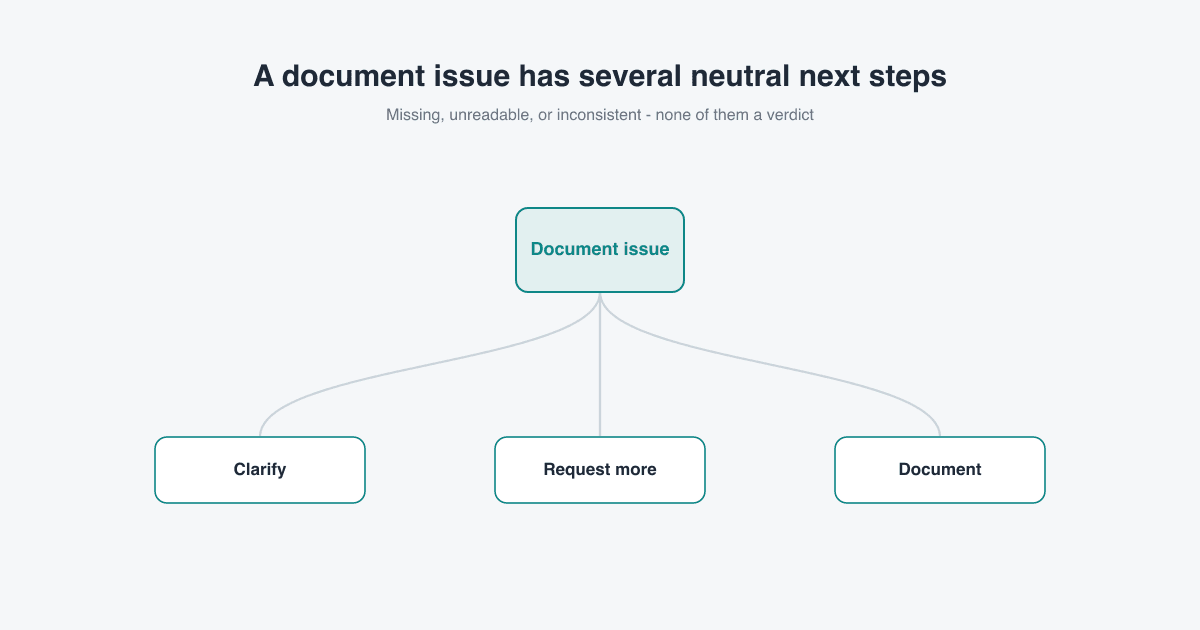
Key Takeaways
- A missing, unreadable, or conflicting document is a finding about the available evidence - not proof of anything about the applicant.
- Use the same staged path for every applicant - check readability, completeness, and alignment - then route to a specific, neutral next step.
- Ask a neutral clarifying question before drawing any conclusion - a difference is a question to ask, not a verdict.
- Some items can be documented and closed with the limitation noted; others call for additional or alternative evidence, or a closer manual review.
- Verification findings stay separate from your screening criteria and the final rental decision, which remains with the landlord - this is general information, not legal advice.
Sooner or later, every landlord hits a snag in a rental application: a pay stub is too blurry to read, a document the applicant meant to include is missing, or two documents do not quite line up. The instinct in that moment is to reach for a conclusion - and the most common mistake is to treat a document problem as if it were proof of something about the person. It usually is not. A blurry scan is a scan quality issue. A missing page is a missing page. Two numbers that differ can have an ordinary explanation you have not asked about yet.
This guide gives you a calm, staged way to decide the next step for each of these situations - one you can apply the same way to every applicant. It builds on the consistent verification process: this is the part of that process that handles the exceptions. For the end-to-end method, see the complete rental application verification guide.
Three situations, one calm approach
- A document problem
A document that is missing, unreadable, incomplete, or inconsistent - within itself or against other submitted evidence - so that you cannot yet complete the review as-is. It is a fact about the evidence in front of you. It is not, by itself, a fact about the applicant, and it does not mean anyone did anything wrong.
The three situations look different but share one response: slow down, name the specific issue, and take a neutral next step. Missing means something you need was not provided. Unreadable means it was provided but you cannot make out the fields. Conflicting means the information does not agree - inside one document, or between two. In every case the honest framing is the same: you have a question about the evidence, not a verdict about the person.
The decision path
Use the same path for every problem case. Each check either lets the review continue or routes the item to one specific, neutral next step. The diagram shows where each branch leads; the numbered path below is the same procedure in words, and is the authoritative version if the two ever differ.
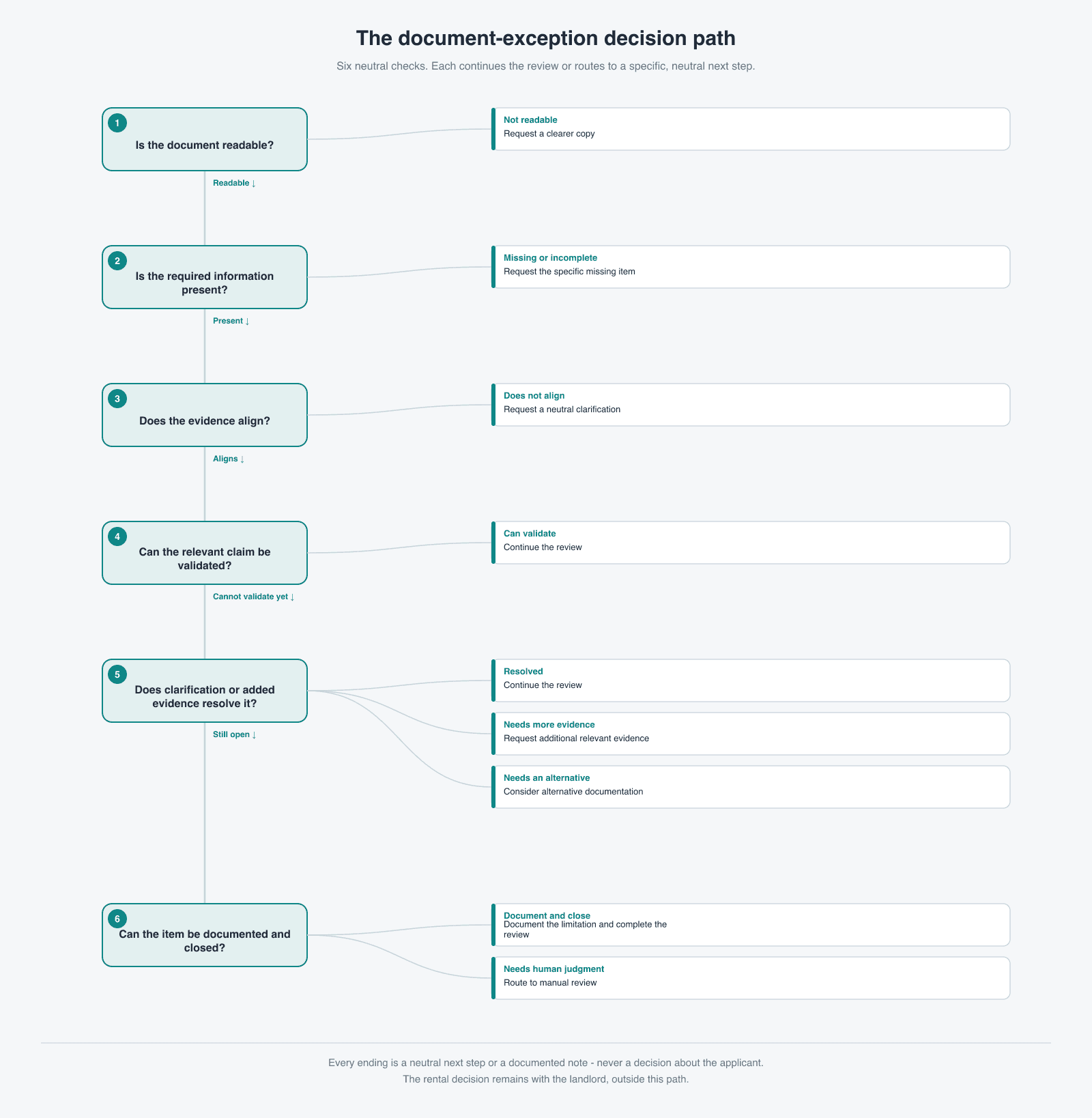
- Request a clearer copy:
- Ask for a more legible version of the same document. Unreadable is a quality issue, not evidence of anything.
- Request the specific missing item:
- Name the specific document or field that is missing and ask for it, using the same request you would send any applicant in the same situation.
- Request a neutral clarification:
- Ask a specific, neutral question about the difference you observed. Describe what the documents show, not what you infer about the person.
- Continue the review:
- The evidence is readable, present, and consistent enough to proceed. Record the finding and continue the standard review.
- Request additional relevant evidence:
- Ask for a further document that would address the open item, chosen for what the applicant situation actually calls for.
- Consider alternative documentation:
- When the usual document does not fit the applicant situation, accept a reasonable alternative that evidences the same thing, and document why.
- Document the limitation and complete the review:
- Record the open item as a documented limitation and complete the review on that basis, noting exactly what remained unresolved.
- Route to manual review:
- Send the item for closer human review when it needs judgment beyond the standard checks. Manual review is a routing step, not a verdict.
Six neutral checks, applied the same way for every applicant. Each check either continues the review or routes to a specific, neutral next step - never to a conclusion about the applicant:
Is the document readable?
Start here. If the file is clear enough to read the fields the review needs, continue to the next check. If it is not, the neutral next step is to request a clearer copy - a hard-to-read file is a legibility issue, not a sign of intent.
Is the required information present?
If the document contains the information this review needs, continue. If part of it is missing or incomplete, request the specific missing item rather than assuming anything about why it is absent.
Does the evidence align?
Check whether the document is internally consistent and whether it agrees with the other evidence submitted. If it aligns, continue. If something does not line up, request a neutral clarification before drawing any conclusion - a difference is a question to ask, not a finding about the person.
Can the relevant claim be validated?
If the submitted evidence is enough to validate the relevant claim, continue the review. If it is not yet enough, move to resolving the open item.
Does clarification or added evidence resolve it?
After a neutral request, decide what the item needs. It may now be resolved, it may call for additional relevant evidence, or it may be better served by alternative documentation that fits the applicant situation. If none of these resolves it, move to how the item is closed.
Can the item be documented and closed?
If the open item can be recorded as a documented limitation and the review completed on that basis, do so. If it needs human judgment beyond the standard checks, route it to manual review. Neither path is a conclusion about the applicant.
The rental decision - applying your lawful screening criteria to the documented findings - is a separate step that happens after this path is complete. It sits outside this decision path, and the decision remains with the landlord. No branch here ends in a decision about the applicant; every ending is a neutral next step or a documented note.
Missing or incomplete documents
When something you need was not provided, or a document arrived with a page or field missing, the neutral next step is simply to request the specific missing item. Name exactly what you need - "the second page of the bank statement" or "a pay stub for the most recent period" - and ask for it the same way you would ask any applicant in the same situation. A missing item is not information in itself; it is the absence of information, and the fix is to request it, not to interpret it.
Requesting a missing item well
- Name the specific document or page, not just 'more documents'
- Explain briefly what it is for, so the request is easy to act on
- Use the same request you would send any applicant missing the same thing
- Record what you requested and when, so the follow-up is documented
Unreadable or low-quality documents
A document you cannot read is a quality problem, not a signal about the person who sent it. Phones take dark photos, scans come out skewed, and older files compress badly. Ask for a clearer copy of the same document, and say what would help - a flat, well-lit photo or a PDF rather than a screenshot. Until you can actually read the fields, the honest status is "unable to validate" - not because anything is wrong, but because you do not yet have a legible document to work from.
When documents conflict
Two documents that disagree, or a single document that is internally inconsistent, are the cases most likely to tempt a premature conclusion. Resist it. A difference is a question to ask, not a finding about the person - and most differences have ordinary explanations: a raise mid-period, a bonus, a pay schedule that straddles the statement dates, a typo on a form.
For the field-by-field mechanics of reading a single document, see how to verify rental income; the point here is narrower - how to route the conflict, neutrally, once you have noticed it.
Information you cannot validate
Sometimes the documents are readable and complete and still do not cover the claim - an income source the submitted evidence only partly evidences, for example. That is a limitation of the evidence. Request additional relevant evidence, consider alternative documentation that fits the applicant's situation, or record it as a documented limitation and complete the review on that basis. Independent research has found third-party screening records can be inaccurate - one more reason to let an applicant clarify before treating any single record as the last word.
Requesting clarification neutrally
When to document and close, or route to manual review
Not every open item can be resolved, and that is acceptable as long as it is handled consistently and recorded honestly. If an item can be documented and the review completed with the limitation noted, do that - write down exactly what remained open and why. If it needs judgment beyond the standard checks, route it to a closer manual review. Both are neutral operational steps. Neither is a conclusion about the applicant, and neither is the rental decision.
Staying fair and consistent
Protect applicant information
These are sensitive financial records, so keep re-requests minimal and secure: ask only for the item the open finding needs, use a secure channel rather than email, limit who can access it, and record the follow-up without copying sensitive figures into free-text notes. Treat every re-request as a chance to collect less, not more. Detailed handling is its own topic.
How Fidem supports this workflow
Common questions
When is it reasonable to stop asking for more?
When the item is either resolved, or can be recorded as a documented limitation and the review completed on that basis. Asking indefinitely is not more fair; handling the item consistently and documenting the outcome is.
Does following this path mean I am complying with fair-housing law?
No. A neutral, documented, consistently applied path is a reasonable operational practice, not a legal guarantee. Fair-housing and consumer-report requirements vary by jurisdiction; consult an attorney for your situation.
Does Fidem decide whether a document is genuine?
No. Fidem surfaces neutral verification signals - such as "additional verification required" or "unable to validate" - for your review. It does not determine document authenticity, conclude intent, or make the rental decision.
Sources
- Using Consumer Reports: What Landlords Need to Know — Federal Trade Commission (accessed 2026-07-14)
- Tenant Background Checks and Your Rights — Federal Trade Commission (accessed 2026-07-14)
- HUD Handbook 4350.3, Chapter 4 — Waiting List and Tenant Selection — U.S. Department of Housing and Urban Development (accessed 2026-07-14)
- The Fair Housing Act — U.S. Department of Housing and Urban Development (accessed 2026-07-14)
- CFPB Reports Highlight Problems with Tenant Background Checks — Consumer Financial Protection Bureau (accessed 2026-07-14)
The consumer-report and adverse-action boundary is cited to the FTC's landlord and applicant-rights guidance; the consistency principle to HUD Handbook 4350.3 (used as an operational practice, with its HUD-assisted-housing applicability caveat, not as a claim of universal applicability) and the durable non-discrimination anchor to the Fair Housing Act; and the screening-record-accuracy context to the CFPB. Product statements describe Fidem's document-review workflow only and assert no authenticity or intent determination. No unsourced statistics are used, and no jurisdiction-specific rule is asserted as universal.