
Key Takeaways
- A consistent process does not require identical evidence in every situation - it requires the same documented steps, applied the same way to every applicant.
- Consistency governs what you check, not what you conclude - the final rental decision remains separate from the verification workflow.
- When an applicant's situation calls for different evidence, document that as a deliberate departure from the baseline - it is part of the process, not an exception to it.
- Write the process down once, in seven parts, and every later review is faster, more comparable, and more defensible.
- This is general information about designing a process, not legal advice - fair-housing and consumer-report requirements vary by jurisdiction.
If you review rental applications the way most independent landlords do - looking at what came in, checking what seems important, forming an impression - you already know the problem: it is hard to remember exactly what you checked last time, harder still to explain it consistently to a second applicant. This guide is a concrete way out of that: a seven-part process you write down once and apply the same way to every applicant, plus the one distinction that keeps it fair - consistency governs your process, not your conclusions.
This guide focuses narrowly on building that process. For the end-to-end method once your process is running, see the complete rental application verification guide; and for a printable reference you can pair with your process, see the rental application verification checklist.
What "consistent" means (and what it doesn't)
- A consistent verification process
Applying the same documented steps - the same inputs you note, the same categories of evidence you consider, the same review checks, the same way of recording findings - to every applicant, every time. It does not mean requiring identical documents from every applicant, and it does not mean reaching the same conclusion about every applicant.
The distinction matters because over-correcting is easy: treating "be consistent" as "demand identical paperwork from everyone" produces a less fair process, asking an applicant with non-traditional income for documents that do not fit their situation. The federal principle is that written criteria are applied the same way to every applicant - not that every applicant's evidence looks identical.
The process, step by step
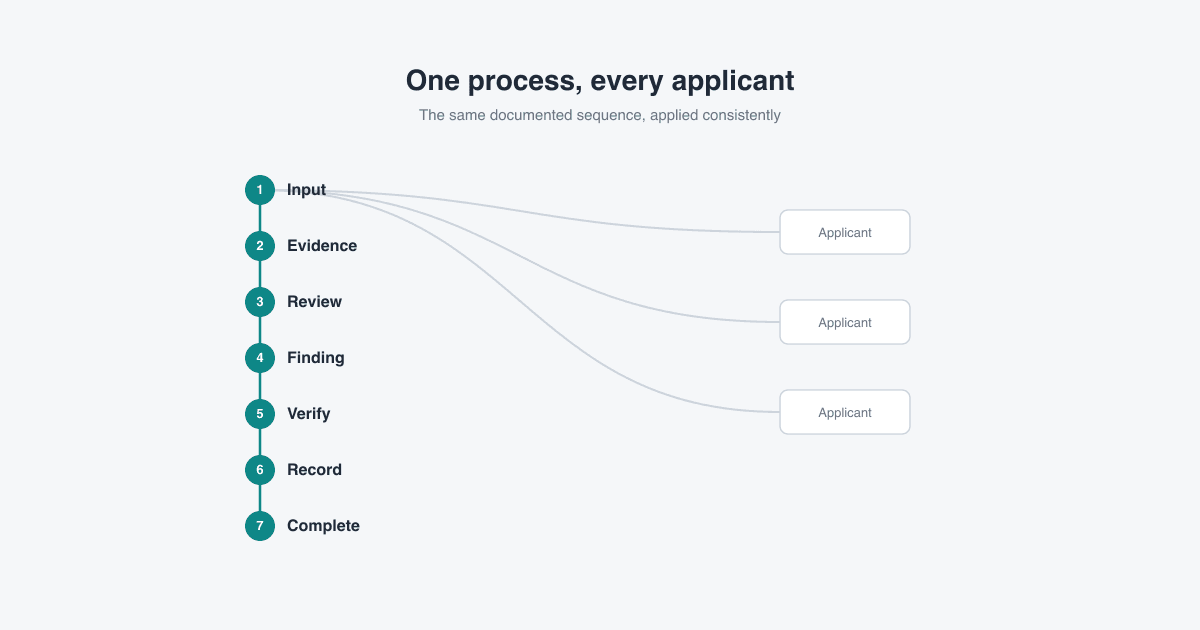
Seven parts, applied the same way for every applicant:
Input
Note what the applicant stated - income, employment or income source, and household details - before you open any documents. This is the reference point every later step checks against.
Evidence
Identify which categories of evidence are relevant to how this applicant is paid, and request them the same way every time.
Relevant evidence varies by income and employment type - that variation is expected, not an exception to the process.
Review step
Review the submitted evidence for internal consistency and for agreement with the stated input, using the same checks for every applicant.
Finding
Record what you found - where the evidence supports the input and where it does not - as a specific, factual note, not a conclusion about the applicant.
Additional verification
When a finding leaves a gap, request the specific missing item or ask a specific question.
This is a deliberate, documented departure from the baseline review - not an exception that excuses the process.
Documentation
Keep a record of what was requested, submitted, reviewed, and found for every applicant, in the same format.
Completion
Define when the review is complete: every input has a corresponding finding, and any additional verification has been resolved or explicitly noted as outstanding.
The rental decision - applying your lawful screening criteria to the documented findings - is a separate step that happens after the process is complete. It sits outside this verification process, and it belongs to the landlord. Keeping that boundary explicit is what lets the process stay narrowly about review, not about who gets the apartment.
Make this your standard process
A process only works if it is the same one every time. Write these seven parts down once - a shared document, a short internal page, or a printed sheet next to your desk - and use it for every application, not just the ones that feel complicated. If you work with anyone else on reviews, give them the same written process rather than explaining it fresh each time. Revisit it periodically: if you notice yourself handling a situation the same nonstandard way more than once, that is usually a sign the written process should be updated to cover it, rather than left as an unwritten exception.
Handling legitimate variation
The most common way this process gets misapplied is treating non-traditional income as a problem rather than a documented variation. Self-employed, contract, and gig-platform income exist and are legitimate; the IRS's own guidance describes the forms and records this income commonly produces. When your baseline evidence categories do not fit an applicant's situation, that is a signal to route to the relevant alternative evidence - not a reason to treat the application differently in kind. For the detailed by-type breakdown of what reasonably evidences each income situation, see proof of income by employment type. When a document is instead missing, unreadable, or conflicting, how to handle missing, unreadable, or conflicting documents gives the neutral, staged decision path for that exception.
Documenting each review
The record of a review is what makes the process defensible later, and it is worth being deliberate about what belongs in it.
What every record should capture
- The input you noted before reviewing documents
- Which evidence categories you requested and why, including any departure from the baseline
- What you found - consistent, inconsistent, or additional verification needed
- Any additional verification requested, and the response
A documented, consistent process is not a guarantee of legal compliance by itself, but it is a meaningfully better position than an undocumented one: independent research has found real accuracy problems in third-party screening reports, which is one more reason a landlord's own documented review - not just a report - matters.
Separate verification from screening criteria and the rental decision
This process produces findings: whether the submitted evidence is consistent with what the applicant stated. It does not set your screening criteria, and it does not make the rental decision. Those are two further layers, both of which stay with you - your lawful, written criteria, applied the same way to every applicant, and the decision itself. Keeping the process narrowly about review is what makes it something you can actually apply consistently; a process that also tried to encode your criteria or your decision would stop being a neutral, repeatable procedure.
Protect applicant information
The documents this process reviews are sensitive financial and personal records. Collect only what the evidence step actually calls for, use a secure submission channel rather than email attachments, limit who can access what is collected, and dispose of records securely once they are no longer needed. Handling this consistently is part of the process, not a separate concern. For the full lifecycle, see protecting applicant financial documents.
Review and improve the process
Treat the written process as a living document, not a one-time exercise. If a category of evidence keeps coming up as an unplanned addition, add it to the evidence step. If a finding format keeps needing extra explanation, refine the documentation step. The goal is a process that stays the same across applicants at any given time, while still being allowed to improve over time as you learn what works.
How Fidem supports this workflow
Common questions
Does writing down a process mean I'm automatically complying with fair-housing law?
No. A documented, consistently applied process is a reasonable practice, not a legal guarantee. Fair-housing and screening requirements vary by jurisdiction; consult an attorney for your situation.
What if I have to deviate from my usual evidence request?
Document it as a deliberate departure - what you requested instead and why - rather than leaving it unwritten. A documented departure keeps the process defensible; an unwritten one is what makes review inconsistent.
Where does the rental decision fit into this process?
It doesn't - by design. This process produces documented findings. The rental decision, and the lawful criteria behind it, are a separate step that comes after, and it stays with the landlord.
Sources
- HUD Handbook 4350.3, Chapter 4 — Waiting List and Tenant Selection — U.S. Department of Housing and Urban Development (accessed 2026-07-14)
- The Fair Housing Act — U.S. Department of Housing and Urban Development (accessed 2026-07-14)
- Using Consumer Reports: What Landlords Need to Know — Federal Trade Commission (accessed 2026-07-14)
- Manage Taxes for Your Gig Work — Internal Revenue Service (accessed 2026-07-14)
- Tenant Background Checks Market Report — Consumer Financial Protection Bureau (accessed 2026-07-14)
The consistent-criteria principle is cited to HUD Handbook 4350.3 and the durable non-discrimination anchor to the Fair Housing Act; both are used to support consistency as an operational practice, not as a claim that this template guarantees compliance. The consumer-report and adverse-action boundary is cited to the FTC. Non-traditional income documentation follows IRS guidance on gig work. Screening-report accuracy context is cited to the CFPB's market report. Product statements describe Fidem's document-review workflow only. No unsourced statistics are used, and no jurisdiction-specific rule is asserted as universal.