
Key Takeaways
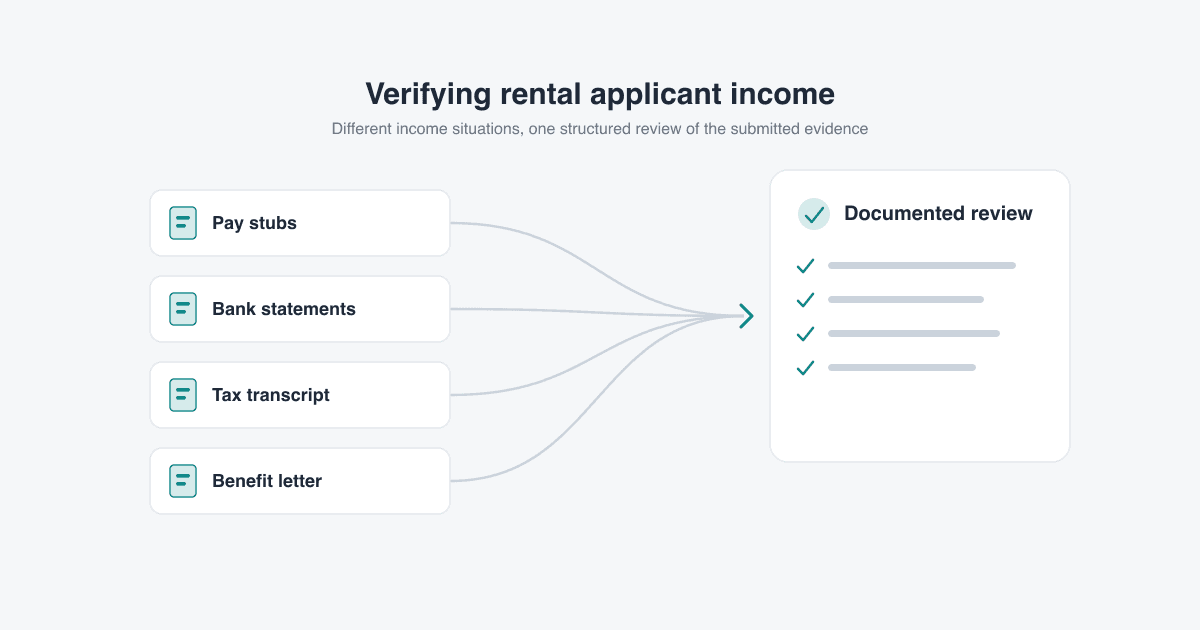
- Income verification is a structured review of the documents an applicant submits - it checks whether the stated income is supported by consistent evidence, not whether to accept the applicant.
- Different income situations document income differently - a salaried employee, a gig worker, and someone on a fixed benefit each show income in their own way, and none is inherently more legitimate.
- Start from the income the applicant stated, identify the income type and pay pattern, then review the relevant documents for internal consistency and agreement across sources.
- Variable or irregular income is normal - review it over a longer period and in context rather than treating it as a problem.
- When the evidence is thin or does not line up, request a specific document or ask a specific question, record what you found, and keep the rental decision - which is yours - separate from the review.
An applicant has told you what they earn and sent documents to back it up. The practical question is what to do with those documents: how do you confirm the stated income is supported by the evidence, and what does "verified" honestly mean once you have? This guide describes a structured way to answer that from the documents an applicant submits, while staying clear about the line between a document review and the decision that is yours to make.
What income verification actually involves
- Income verification
Reviewing the documents an applicant submits - pay stubs, bank statements, and supporting records - to confirm that the stated income is internally consistent, consistent across documents, and consistent with what the applicant put on the application. It is a review of submitted evidence, not an independent audit of the applicant's finances or a certification of their ability to pay.
Verification answers a narrow, useful question: do the documents in front of you support the income the applicant stated? When they do, the documentation supports that figure. When they do not, you have a specific, factual reason to ask for more before you proceed.
Most confusion comes from collapsing four separate things into one. Keeping them apart is what keeps a review both useful and fair:
The verification workflow - what this guide covers: reviewing the submitted documents for consistency.
Your screening criteria - the lawful, written standards you decide to apply, and apply the same way to every applicant.
Legal compliance - fair-housing law, consumer-report duties, and state and local rules.
The rental decision - the choice to proceed, or not, which is yours alone.
Income verification lives entirely in the first layer. A review that stays in its lane is more trustworthy precisely because it does not pretend to do the other three jobs. What it does not establish is set out in full under what verification does not tell you.
Match the situation to relevant evidence
Start from the figure the applicant put on the application - that is what you check the evidence against - then identify how they are actually paid, because the evidence that fits one situation does not fit another.
The matrix routes common income situations to the evidence that may be relevant, what to review it for, and a neutral next step when the evidence is thin. These are categories to consider, not a required checklist and not rules about who to accept. Throughout, the documents are ones the applicant obtains and provides; you are reviewing what they submit, not pulling records yourself. For a quick lookup by employment type, see proof of income by employment type.
| Income situation | Evidence categories that may be relevant | What to review for consistency | If the evidence is thin |
|---|---|---|---|
| Salaried employment | Recent pay stubs; bank statements showing matching payroll deposits; an employment letter if they have one | Gross and net pay, year-to-date against the pay schedule, net pay against the deposits | Ask for the adjacent pay periods, or an explanation of any gap |
| Hourly employment | Several recent pay stubs; bank statements showing the deposits | Whether the range across periods fits the hours and rate shown | Request more periods so the normal range is visible, rather than reading one as the whole picture |
| Variable, seasonal, or commission income | A longer run of pay stubs or statements; commission statements if they have them | The pattern over several months, not a single high or low period | Extend the period reviewed, or ask how the income is structured across a year |
| Contract or gig work | Bank statements showing deposits; 1099 forms; invoices or a platform earnings summary | Whether recurring deposits line up with the stated work and sources | Ask for a longer statement window, or further 1099s that show the pattern |
| Self-employment | A recent tax return or IRS transcript the applicant obtains; business bank statements; a profit-and-loss summary | Whether the documents are internally consistent and cover a representative period | Request an additional period, rather than treating one document as the whole answer |
| Retirement or pension income | A pension or retirement award letter; bank statements showing the deposits; a 1099-R if they have one | Whether the recurring deposit matches the award letter | Ask for the award letter, or a statement showing the deposit |
| Government or other benefit income | A benefit verification letter the applicant obtains (for example, from the SSA); bank statements showing the deposits | Whether the letter and the deposits agree; benefit income is reviewed like any other recurring income | Ask for a current benefit verification letter, or a statement showing the deposit |
| Savings or other liquid assets | Recent bank or brokerage statements the applicant provides | Whether balances are consistent across statements; assets are context alongside income, not a substitute for it | Ask for a more recent statement, and read the assets alongside the income evidence |
| More than one income source | The relevant documents for each separate source | Each source on its own terms, then the combined picture against the application | Request what is missing for that source, rather than setting aside the whole application |
The IRS's gig-work guidance covers the forms self-employed and gig workers commonly receive, and an applicant can obtain an IRS transcript of their own tax records; a benefit recipient can request a verification letter from the Social Security Administration. In every row the point is the same: match the evidence to how the person is actually paid, and read it for consistency.
Review the evidence for consistency
The review itself is a short, repeatable sequence with two layers - checking each document against itself, then checking the documents against each other and against the application.
A sequence you can run for every applicant, whatever their income situation:
Confirm the documents belong to your applicant
Check that the name on each document matches the applicant, and that the income source named is the one they stated.
Read each document on its own
For a pay stub, read gross pay, net pay, year-to-date totals, the pay-period dates, and the pay frequency. For a statement, read the period, the deposits, and the balances.
Check internal consistency
Within a single document, confirm the figures agree - for example, that a year-to-date total is consistent with the pay frequency and the number of periods elapsed.
Compare across documents
Check that net pay is broadly consistent with the payroll deposits on a bank statement, and that the income source appears consistently across the documents.
Compare against the application
Check that the documents, taken together, support the income the applicant stated - not to the dollar, but as a coherent picture.
Note what lines up and what does not
Record where the evidence supports the stated income and where a figure, a period, or a source does not yet agree.
A difference is a prompt to ask a specific question, not a conclusion about the applicant.
For the field-by-field method see how to review a pay stub; for how much history to request, how many pay stubs to request; for the deposit side, the bank statement review guide. This guide ties income evidence together across situations and sits inside the broader review in the complete rental application verification guide.
Reviewing variable or irregular income
Income that moves period to period is common and entirely legitimate - hourly schedules, commissions, seasonal work, self-employment, and gig work all produce a figure that varies. The review does not treat that movement as a problem; it reads it over a longer window so the normal range is visible.
The point is to understand the pattern, not to penalize an applicant for having one. Averaged over a representative period, irregular income often supports a stated figure that any single period would not.
When evidence is missing or does not line up
Documents are frequently incomplete, hard to read, or slightly off, and the applicant is usually not at fault. Request the specific missing item, ask for a clearer copy of anything unreadable, and put a specific, factual question to any figure that does not agree. The CFPB has documented meaningful accuracy problems in third-party tenant-screening reports - a strong argument for letting an applicant clarify a discrepancy in their own documents rather than treating one data point as settled. For the full method, see handling missing, unreadable, or conflicting documents.
Protecting applicant financial information
Pay stubs, bank statements, and tax documents are sensitive records, and handling them responsibly is part of the review. The most private document is the one you never collect: ask for the specific evidence the applicant's income situation calls for rather than every financial record, receive it through a secure channel rather than email, limit who can open it, and dispose of it securely when it is no longer needed. For the full lifecycle, see a landlord's guide to financial document privacy.
Record what you reviewed
A documented review is repeatable, comparable across applicants, and defensible if a decision is ever questioned. For each application note which documents arrived and when, which fields you reviewed, what was and was not consistent, anything you requested and the response, and a short summary tied to the supporting evidence. Notes like "year-to-date reviewed and consistent with the stated pay frequency" record your process, not just your conclusion. For a printable list, see the rental application verification checklist.
What verification does not tell you
It does not certify ability to pay. Verification confirms the documents support a stated income; whether that income is sufficient, and whether the applicant will keep earning it, are separate questions the documents cannot answer.
It does not prove a document is genuine. Checking that figures agree tells you a document is internally consistent, not that it is authentic.
It does not set an income requirement. There is no single national income rule; a "three times the rent" figure is a common convention, not a legal requirement. Any standard you apply, and the decision itself, are yours.
Document review is separate from a consumer report. Reviewing submitted documents is distinct from running a third-party screening report, which carries its own duties.
How Fidem supports income verification
Common questions
Is a landlord allowed to just pull an applicant's income records?
Generally no - the documents in an income review are ones the applicant obtains and provides, such as pay stubs, bank statements, a tax transcript they request, or a benefit verification letter they download. You review what they submit rather than accessing third-party records yourself, and using a third-party consumer report is a separate process with its own legal duties.
How much income does an applicant need?
That is a question about your screening criteria and the rental decision, not about verification. There is no single national rule; conventions like "three times the rent" are common but are not law. Whatever standard you use, apply it consistently to every applicant, and keep it separate from the document review, which only tells you whether the evidence supports the stated income.
Does a mismatch mean the applicant misrepresented their income?
No. A mismatch means the documentation does not yet agree or is incomplete. It is a reason to ask a specific question or request another document, not a conclusion about the applicant.
Sources
- Understanding Your Pay Stub — Consumer Financial Protection Bureau (accessed 2026-07-14)
- Get Your Tax Records and Transcripts — Internal Revenue Service (accessed 2026-07-14)
- Manage Taxes for Your Gig Work — Internal Revenue Service (accessed 2026-07-14)
- How Can I Get a Benefit Verification Letter? — U.S. Social Security Administration (accessed 2026-07-14)
- Tenant Background Checks Market Report — Consumer Financial Protection Bureau (accessed 2026-07-14)
- Using Consumer Reports: What Landlords Need to Know — Federal Trade Commission (accessed 2026-07-14)
- The Fair Housing Act — U.S. Department of Housing and Urban Development (accessed 2026-07-14)
Income-document definitions follow the CFPB's pay-stub tool and the IRS's guidance for gig and self-employed workers; the benefit verification letter follows SSA guidance; the consumer-report and adverse-action boundary is cited to the FTC and the fair-housing boundary to the HUD-published Fair Housing Act. Screening-report accuracy is cited to the CFPB's market report. Product statements describe Fidem's document-review workflow only. No unsourced statistics are used, and every income situation is described in general terms with no applicant data.