
Key Takeaways
- Different income and employment types are evidenced by different documents - there is no single list that applies to every applicant.
- Non-traditional income (self-employment, contract work, gig platforms, retirement, benefits) is legitimate, and each has its own reasonable evidence and acceptable alternatives.
- Which document is relevant, and what protections apply to an applicant's source of income, vary by jurisdiction - no single evidence list applies universally.
- The type of document an applicant provides says nothing about how reliable they are - reasonable evidence exists for every income situation described here.
- This comparison shows possible evidence, not a decision - what to accept, and the rental decision itself, remain the landlord's, and this is not legal advice.
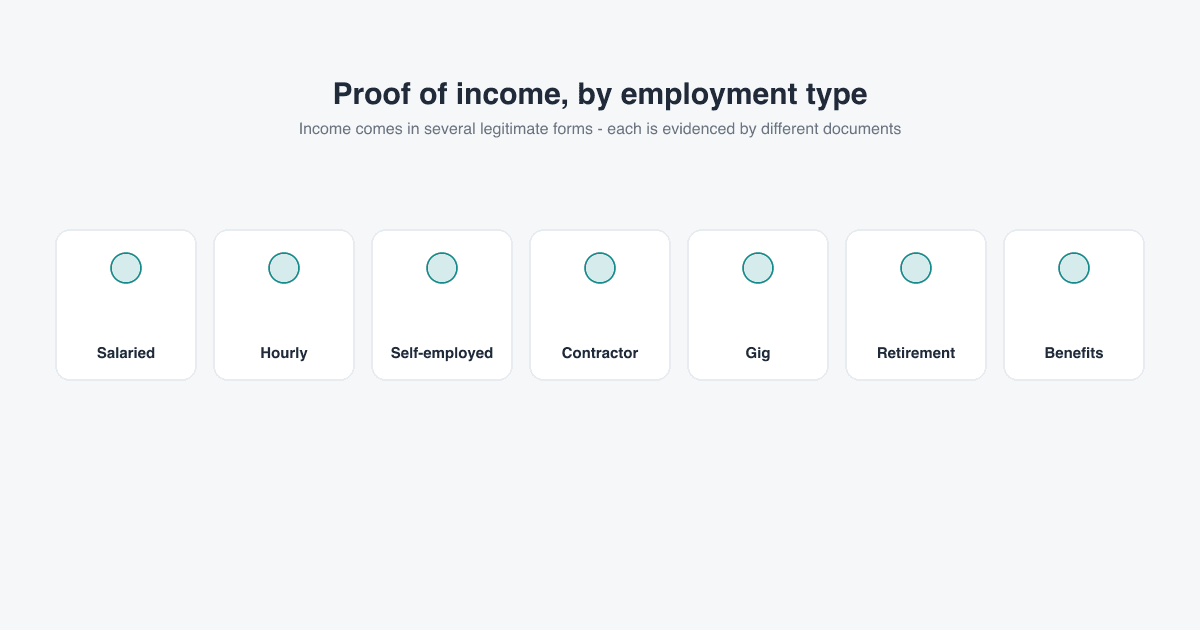
An applicant who isn't a standard salaried employee still has income - it just shows up in different documents. This comparison is a quick reference: look up an applicant's employment type, and see which documents may reasonably evidence their income, plus the acceptable alternatives when the usual document doesn't apply. It stays narrowly focused on that lookup. For the fuller review method - starting from the stated income, checking consistency, and handling variability - see how landlords can verify rental applicant income. This comparison does not decide anything: it does not rank income types, set a document requirement, or determine the rental decision, which stays yours.
How to use this comparison
The comparison
| Income or employment type | Common payment pattern | Possible evidence | Acceptable alternatives | Possible follow-up |
|---|---|---|---|---|
| Salaried employment | Regular, fixed amounts on a set schedule | Recent pay stubs; an offer or employment letter | A written employer statement of pay, if pay stubs are unavailable | Ask for an adjacent pay period or a brief employer statement |
| Hourly employment | Amounts move with hours worked, often on a regular schedule | Several recent pay stubs covering a consistent period | A recent time-and-pay summary from the employer, if pay stubs are unavailable | Request additional periods so the usual range is visible |
| Commission or variable pay | Amounts rise and fall from period to period | A longer run of pay stubs or commission statements | A recent tax return or transcript showing a fuller-year picture | Extend the period reviewed rather than reading one period alone |
| Contract work (1099) | Payments tied to specific engagements, often irregular | A 1099-NEC; bank statements showing the deposits; signed contracts or invoices | A recent tax return or an IRS transcript the applicant obtains and provides | Ask for a longer statement window or an additional 1099 |
| Gig-platform work | Frequent, often small payments from one or more platforms | A 1099-K or 1099-NEC, where issued; a platform earnings summary; bank deposits | A recent tax return or an IRS transcript the applicant obtains and provides | Ask for a longer statement window or a platform earnings summary |
| Self-employment | Business income, often irregular | A Schedule C from a recent tax return; business bank statements | An IRS tax return or wage-and-income transcript the applicant obtains and provides | Request an additional period or a transcript rather than one document alone |
| Retirement income | Regular, recurring payments | A pension or retirement award letter; a 1099-R; bank statements showing the deposits | A recent account statement from the plan administrator | Ask for the award letter or a recent statement showing the deposit |
| Government or other benefits | Regular, recurring payments | A benefit verification letter (for example, an SSA benefit verification letter); bank statements showing the deposits | A recent official benefits-program statement, where a verification letter is unavailable | Ask for a current benefit verification letter or a statement showing the deposit |
| Savings or other liquid assets | A balance, rather than a recurring payment | Recent bank or brokerage statements | Statements from more than one account, read together as context alongside income evidence | Ask for a more recent statement; consider assets alongside income, not as a substitute for it |
| More than one income source | A combination of the patterns above | The relevant evidence for each separate source | The alternatives listed for each individual source, applied separately | Request whatever is missing for a specific source, rather than setting the whole application aside |
Reading the rows in practice
The table is the reference; these are the details it cannot carry.
Employment income. A recent pay stub shows the pay period, frequency, and gross and net pay; several together show a pattern. Reading those fields in detail is its own method - see how to review a pay stub. Where stubs are unavailable, a written employer statement covering the same information is a reasonable alternative.
Self-employment, contract, and gig work. Income arrives as tax records, 1099 forms (1099-NEC or 1099-K, depending on how the work was paid), invoices, platform earnings summaries, and business bank deposits. Where a tax return itself is unavailable, an applicant can request their own IRS return or wage-and-income transcript; separately, an applicant may authorize a third party to request a transcript through the IRS's Income Verification Express Service. None of this is less reliable than salaried income - it is evidenced differently, usually over a longer period than one recent stub.
Retirement and benefit income. A pension or retirement award letter, a 1099-R, or a benefit verification letter the recipient requests through their own account - each read against the recurring deposits it corresponds to, exactly as any other recurring income is.
Savings and other assets. Bank or brokerage statements are context alongside income, not a replacement for it. A one-time balance does not establish recurring income the way a pattern of deposits does, so more than one period is more informative than a single snapshot.
When more than one income source applies
Many applicants have more than one source - a salaried job plus a side gig, or retirement income plus part-time hourly work, for example. In that case, apply the relevant row to each source individually, then look at the combined picture. A gap in one source is a reason to ask about that specific source, not a reason to set aside the documentation for the others.
When the submitted evidence is insufficient
Reasonable evidence and acceptable alternatives cover most situations, but sometimes what's submitted still leaves a gap - a document is missing, unreadable, or doesn't cover enough history. The neutral next step is the same regardless of employment type: ask for the specific missing item, a clearer copy, or a longer period, rather than treating the gap itself as a finding about the applicant. The fuller method for comparing submitted evidence and following up consistently is covered in how landlords can verify rental applicant income, and the staged way to decide the next step for a missing, unreadable, or conflicting document is in how to handle missing, unreadable, or conflicting documents.
Protecting sensitive income documents
Tax returns, transcripts, and benefit letters carry sensitive personal and financial information - often more sensitive than a routine pay stub. Request only the documents your review actually needs for the applicant's specific income situation, collect them through a secure channel, limit who can access them, and dispose of them securely once they're no longer needed. For the full collection-to-deletion practice, see handling applicant financial documents responsibly.
Fairness and scope
How Fidem supports reviewing varied income documents
Common questions
Is one type of income more trustworthy than another?
No. Every income type in this comparison has reasonable supporting evidence; the type of document reflects how someone is paid, not how reliable they are.
What if my applicant has none of the listed documents?
Ask what they do have. The alternatives column covers the common substitutes, and a tax transcript or a recent bank statement can often stand in when the usual document for a category isn't available.
Can I require the same documents from every applicant regardless of employment type?
You can apply the same process to everyone, but requiring an identical document list regardless of how someone is actually paid can unfairly disadvantage non-traditional earners. Match the request to the applicant's income situation instead.
Does this comparison replace the full verification method?
No. This is a quick reference for which documents fit which employment type. For the complete method - starting from stated income, checking consistency, and handling variable income - see how landlords can verify rental applicant income.
Sources
- Manage Taxes for Your Gig Work — Internal Revenue Service (accessed 2026-07-14)
- Get Your Tax Records and Transcripts — Internal Revenue Service (accessed 2026-07-14)
- Income Verification Express Service (IVES) — Internal Revenue Service (accessed 2026-07-14)
- How Can I Get a Benefit Verification Letter? — U.S. Social Security Administration (accessed 2026-07-14)
- Recordkeeping and Reporting (Fair Labor Standards Act) — U.S. Department of Labor (accessed 2026-07-14)
- HUD Handbook 4350.3, Chapter 4 — Waiting List and Tenant Selection — U.S. Department of Housing and Urban Development (accessed 2026-07-14)
- The Fair Housing Act — U.S. Department of Housing and Urban Development (accessed 2026-07-14)
Self-employment, contractor, and gig-income documentation follows IRS guidance on gig work and on obtaining tax transcripts, including the IRS's third-party-authorized Income Verification Express Service. Benefit income follows SSA guidance on the benefit verification letter. The statement that no federal law requires an employer to issue a pay stub follows U.S. Department of Labor recordkeeping guidance. The consistently-applied-criteria principle is cited to HUD Handbook 4350.3, and the non-discrimination and source-of-income caveat to the Fair Housing Act. Product statements describe Fidem's document-review workflow only. No unsourced statistics are used, and no income type is presented as more legitimate than another.