
Key Takeaways
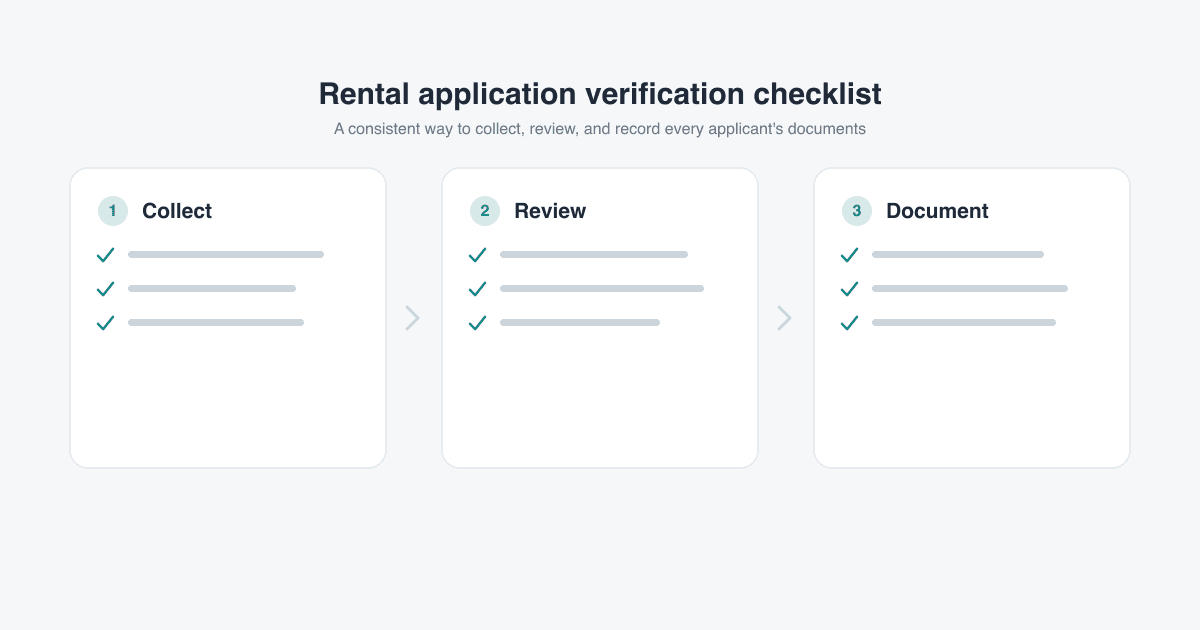
- Collect the same core documents for every applicant - recent pay stubs, bank statements, and supplemental records when income is non-traditional.
- Review each document for its key fields, then compare across documents for internal and cross-document consistency.
- Record what you reviewed, what you found, and any follow-up you requested, so the review is repeatable for every applicant.
- This is a document review, not a decision - it produces notes and follow-up requests, never a verdict on the applicant, and the rental decision stays with you.
- Print or download the checklist and run the same steps every time.
This is a working checklist for reviewing the documents in a rental application - what to collect, what to check in each document, and how to keep a record - organized so you can run it the same way for every applicant. It covers the income and deposit documents an applicant submits; it is not a credit, criminal, or eviction-history check, and it does not decide who becomes your tenant. For the full explanation behind each step, see the complete rental application verification guide. To work from a copy on paper, download the printable version.
How to use this checklist
Collect
Decide your document list before you start, and request the same core set from everyone. Collect only what your review needs, and store it securely. For your own collection-to-deletion practice, see how to protect applicant financial documents.
Before you collect documents
- Decide which documents you will request from every applicant, and apply the same list consistently.
- Note the income and employment the application states, so you have figures to compare the documents against.
- Request only the documents your review actually uses, and plan to store them securely and dispose of them when they are no longer needed.
Collect the documents
- Recent pay stubs covering a consistent, current period (commonly the last two to three months).
- Recent bank statements covering a defined period (commonly the last two to three months).
- Supplemental income documentation when income is non-traditional (self-employment, contract, gig, retirement, or benefit income).
- Collect the documents through a secure channel rather than email attachments, and limit who can access them.
How many pay stubs to request, and the coverage that makes these comparisons possible, is a separate question - see how many pay stubs a landlord should request.
Review
Read the relevant fields in each document, then compare across documents. This checklist keeps the field checks brief; for the field-by-field method, see how to review a pay stub, the bank statement review guide, and how to verify rental applicant income.
Review each document
- On each pay stub, read gross pay, net pay, year-to-date totals, the pay-period dates, the pay frequency, and the employer and employee names.
- Check that the year-to-date total is consistent with the stated pay frequency and the number of pay periods elapsed.
- On each bank statement, read the opening and closing balances, the total deposits, and any recurring deposits.
- Confirm each document is complete and legible, and request a clearer copy of anything unreadable.
Compare across documents
- Compare the income stated on the application against the pay-stub figures.
- Compare net pay against the payroll deposits shown on the bank statements.
- Check that the employer name appears consistently across the documents.
- Check that the pay periods and statement periods are recent and overlap as expected.
When the documents line up, the documentation supports the stated income. When they do not, you have a specific, factual thing to ask about - not a conclusion.
Document
Keep a record of what you reviewed. A documented review is repeatable across applicants, and it gives you a consistent record if a decision is ever questioned.
Record what you reviewed
- Note which documents were submitted, and when.
- Note which fields you reviewed in each document.
- Note anything that did not line up, and any clarification or additional documentation you requested.
- Record a short summary of your findings, tied to the supporting documents.
When something needs follow-up
- When a figure does not reconcile, a period is missing, or a name differs, request the specific document or ask a specific, factual question.
- Treat a missing or inconsistent item as a reason to ask, not as a conclusion about the applicant.
- Keep the rental decision separate from the document review, and apply your written criteria consistently to every applicant.
Scope and limits
Download the printable checklist
The same checklist, as a one-page-per-side printable PDF you can keep on file and run for every applicant. It contains the identical items shown above.
Rental Application Verification Checklist (printable)PDF · 7 KBHow Fidem structures this
Sources
- Understanding Your Pay Stub — Consumer Financial Protection Bureau (accessed 2026-07-14)
- Tenant Background Checks Market Report — Consumer Financial Protection Bureau (accessed 2026-07-14)
- Protecting Personal Information: A Guide for Business — Federal Trade Commission (accessed 2026-07-14)
- Using Consumer Reports: What Landlords Need to Know — Federal Trade Commission (accessed 2026-07-14)
Pay-stub field references follow the CFPB's consumer-education tool; the value of a documented, consistent record is supported by the CFPB's tenant-screening market report. Secure-handling guidance cites the FTC's guide for businesses; the consumer-report and adverse-action boundary is cited to the FTC's guidance for landlords - all verified on the access dates shown. Product statements describe Fidem's document-review workflow only. Requirements vary by jurisdiction and change over time; no statistics are used.