
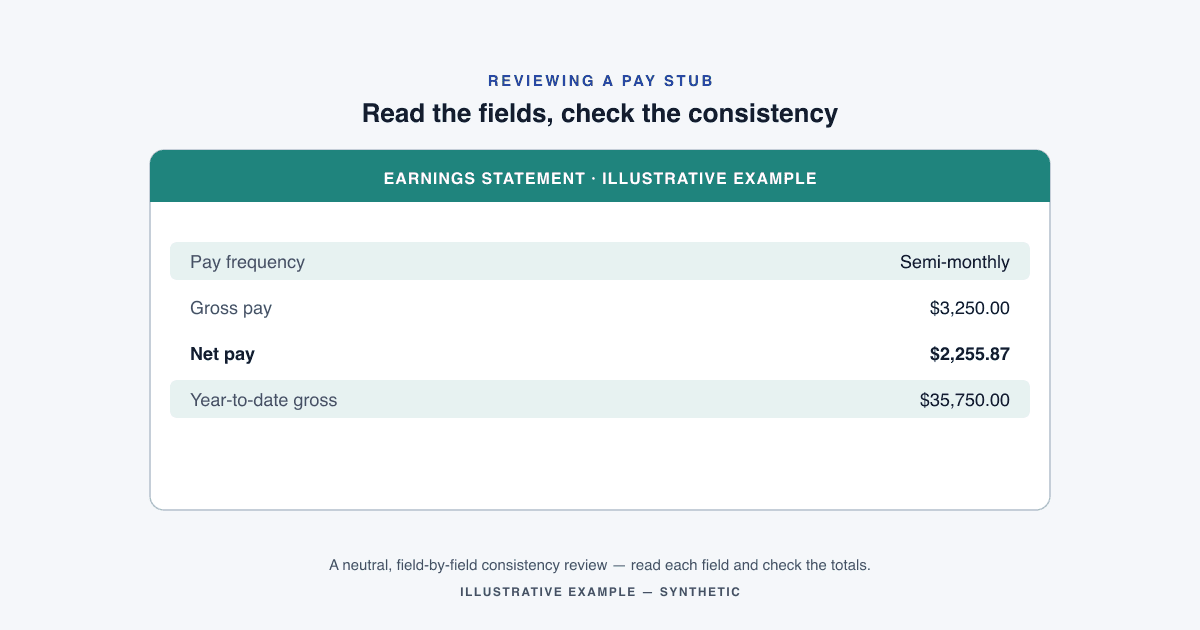
Key Takeaways
- A pay stub is one piece of evidence — it shows what an employer reported for a pay period, but on its own it cannot confirm a document is genuine or establish the applicant's full income picture.
- Read every field first — employer, pay period, pay frequency, gross pay, deductions, net pay, and year-to-date totals — before drawing any conclusion.
- Check internal consistency (net pay equals gross minus deductions; year-to-date roughly equals per-period pay times the periods elapsed) and cross-document consistency (net pay against bank deposits).
- Treat anything that does not line up as a question to ask, not a verdict — request the specific missing or clarifying document, and record what you found.
You have a pay stub in front of you, and the question is a practical one: what do all these fields mean, and how do you check that they hold together? This guide is a field-by-field method for reading a submitted pay stub and reviewing it for consistency — within the document itself and against the other documents an applicant provides.
It is deliberately a review method, not a way to accuse anyone. A pay stub records what an employer reported for a single pay period. Read carefully, it tells you whether the figures on the page are internally consistent and whether they agree with the rest of the application. It does not, on its own, confirm that a document is genuine or establish an applicant's whole income picture — and a figure that does not line up is a reason to ask a specific question, never a conclusion about the person.
What a pay stub can and cannot tell you
A pay stub is a periodic statement of earnings and deductions. It can show you the employer, the pay period, how often the employee is paid, the gross and net amounts for the period, what was deducted, and the year-to-date totals. Read across several periods, it can show you whether those figures accumulate the way the stated pay frequency implies.
What a single pay stub cannot do is prove the applicant's total income, confirm the employment relationship on its own, or establish that the document itself is genuine. Those are separate questions that need additional evidence — which is exactly why a pay stub is reviewed alongside other documents rather than trusted in isolation.
The fields on a pay stub
Most pay stubs carry the same core fields, whatever the format. The Consumer Financial Protection Bureau's guide to reading a pay stub is a good neutral reference for what each figure means. The annotated example below is entirely synthetic — every name, figure, and date is invented and internally consistent — and the numbered callouts mark the fields worth reading.
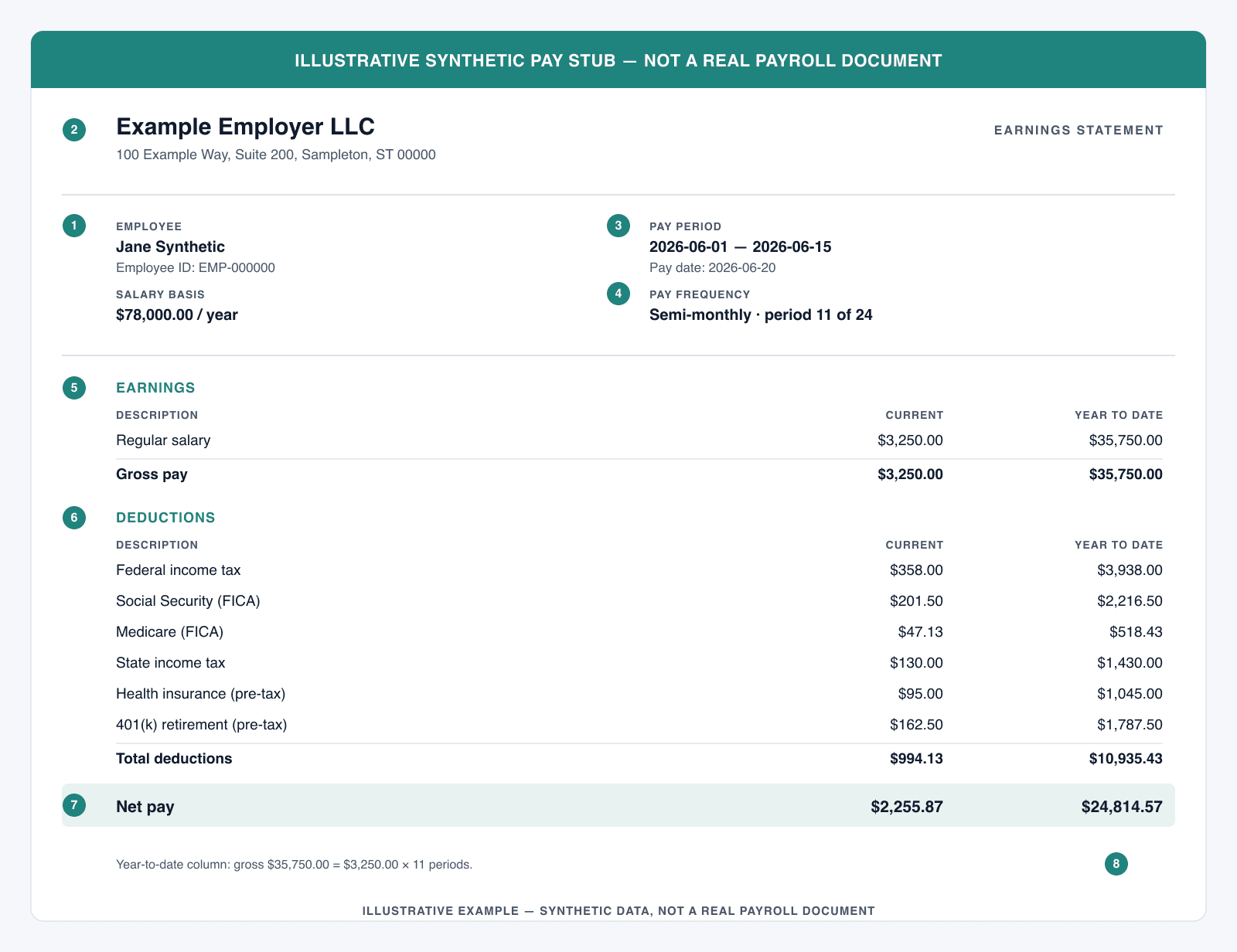
- 1. Employee:
- The employee named on the stub. Confirm it matches the applicant on the rental application; a name that does not match is a reason to ask, not a conclusion.
- 2. Employer:
- The employer's name and address. Compare it with what the applicant stated and with the payroll descriptor on any submitted bank statement.
- 3. Pay period:
- The dates this stub covers and the pay date. Confirm the periods are recent and, across multiple stubs, that they run in sequence without unexplained gaps.
- 4. Pay frequency:
- How often the employee is paid — here, semi-monthly (24 periods a year). Pay frequency is what makes the year-to-date check meaningful.
- 5. Gross pay:
- Total earnings for the period before deductions. Gross pay should equal the sum of the earnings lines above it (regular pay plus any overtime or bonus).
- 6. Deductions:
- Taxes and other amounts withheld — federal and state income tax, Social Security and Medicare (FICA), and any benefits. They should sum to the total-deductions line.
- 7. Net pay:
- Take-home pay: gross pay minus total deductions. Recalculate it yourself, and compare it against the deposits on a submitted bank statement.
- 8. Year-to-date totals:
- Cumulative totals for the year. Year-to-date gross should be roughly the per-period pay times the number of periods elapsed; a large mismatch is worth a closer look.
- Gross pay, net pay, and deductions
Gross pay is total earnings for the period before anything is taken out. Deductions are the amounts withheld — federal and state income tax, Social Security and Medicare (FICA), and voluntary items such as health insurance or a retirement contribution. Net pay is what remains: gross pay minus total deductions, the "take-home" amount.
The two checks to run first
If you read nothing else on a stub, run these two. Both are arithmetic you can do by hand, and between them they catch most of what a single stub can tell you.
- Pay period, pay date, and pay frequency
The pay period is the span of time the stub covers. The pay date is when the employee was actually paid (usually shortly after the period ends). The pay frequency is how often pay is issued — weekly (52 periods a year), bi-weekly (26), semi-monthly (24), or monthly (12).
1. The figures on the stub reconcile. Gross pay should equal the sum of the earnings lines (regular pay plus any overtime or bonus), the individual deduction lines should sum to total deductions, and net pay should equal gross minus total deductions. On the synthetic example above, $3,250.00 minus $994.13 is exactly $2,255.87.
2. Year-to-date fits the pay frequency. Year-to-date gross is the cumulative total from the start of the year, so for steady pay it should be close to the per-period amount times the number of periods elapsed. Semi-monthly at $3,250, eleven periods in, puts year-to-date gross near $35,750. Knowing the frequency is what turns the year-to-date column from a number into a check.
A one-time bonus, a raise, or a recent start date can all move the year-to-date figure for legitimate reasons, so a difference is a prompt to ask — not a finding. The point of the check is to notice the difference, not to explain it for the applicant. When a stub is missing, unreadable, or does not line up, how to handle missing, unreadable, or conflicting documents gives a neutral, staged way to decide the next step.
Review a pay stub, step by step
The same review, as a sequence you can run for every stub:
Confirm the stub belongs to your applicant
Check the employee name — and the employer, where it also appears on the application — against what the applicant stated.
Note the employer, the period, and the frequency
The employer name and address, the pay-period dates, the pay date, and whether pay is weekly, bi-weekly, semi-monthly, or monthly.
Reconcile the arithmetic
Gross pay against its earnings lines, the individual deduction lines against total deductions, and net pay against gross minus deductions. Do the subtraction yourself rather than assuming the printed figure.
Check year-to-date against the frequency
Year-to-date gross should be roughly the per-period pay times the periods elapsed.
A one-time bonus, a mid-year raise, or a later start date can move this figure legitimately — a difference is a prompt to ask, not a verdict.
Compare across documents
Compare net pay to the deposits on a submitted bank statement, and the employer name across documents.
See the bank statement review guideRecord what you found and request clarification where needed
Note anything that does not line up, and request the specific missing or clarifying document in neutral, document-focused language.
Comparing across documents
A pay stub is most informative next to the other documents an applicant provides. Cross-document checks ask whether the stub agrees with the application and with the bank statements.
| Check | Documents involved | What you are looking for |
|---|---|---|
| Net pay vs. deposits | Pay stub, bank statement | Net pay broadly consistent with the payroll deposits shown on the statement |
| Year-to-date vs. frequency | Pay stub | Year-to-date gross roughly equal to per-period pay times the periods elapsed |
| Employer name | Pay stub, bank deposit descriptor, application | The same employer appearing consistently across the documents |
| Pay-period sequence | Multiple pay stubs | Consecutive, current periods without unexplained gaps |
| Gross-to-net arithmetic | Pay stub | Net pay equal to gross pay minus the listed deductions |
How many stubs to request is a separate question — see how many pay stubs to request. Pay stubs are also only one kind of income evidence: for the full picture see how to verify rental applicant income, or proof of income by employment type for non-traditional income.
When something does not line up
Whatever does not line up, the next step is the same: request the specific item or ask a specific, factual question, and record it. Phrase it around the document rather than the person — "the year-to-date figure on the June stub is lower than the pay rate would suggest; could you provide the April and May stubs?" is accurate and respectful.
What a pay-stub review is not
Being clear about the limits keeps the review both useful and fair.
It is not proof of employment or total income. A stub is one piece of evidence about one pay period; confirming employment or the full picture needs more.
It is not a document-authentication check. Checking arithmetic tells you a document is internally consistent, not that it is genuine. No single field or visual characteristic establishes authenticity.
Formats legitimately vary. No federal law requires an employer to issue a pay stub; the Fair Labor Standards Act requires employers to keep payroll records, and issuance is governed by state law. There is no single "correct" layout, so an unfamiliar format is not by itself meaningful.
Screening criteria and the rental decision are separate, and yours. Reviewing a document does not set them for you.
A consumer report carries its own duties. Reviewing a submitted stub is distinct from running a third-party screening report. If you do the latter, the Fair Credit Reporting Act imposes obligations, including an adverse-action notice when a report contributes to an unfavorable decision.
How Fidem reviews pay stubs
For the end-to-end workflow this fits into, see the complete rental application verification guide. And for handling that document responsibly across its lifecycle, see protecting applicant financial documents throughout their lifecycle.
Common questions
How many pay stubs should I ask for?
That is a separate question about quantity and time coverage — see how many pay stubs a landlord should request. This guide is about how to read and check the stubs you receive.
Can a pay stub confirm the applicant's employment?
Not on its own. A pay stub is one piece of evidence about a pay period. Confirming employment or the full income picture generally needs additional documentation — see how to verify rental applicant income.
What should I do when something does not line up?
Request the specific missing or clarifying document in neutral language, note the question and the response, and treat it as additional verification — not a verdict.
Sources
- Understanding Your Pay Stub — Consumer Financial Protection Bureau (accessed 2026-07-13)
- Recordkeeping and Reporting (Fair Labor Standards Act) — U.S. Department of Labor (accessed 2026-07-13)
- Using Consumer Reports: What Landlords Need to Know — Federal Trade Commission (accessed 2026-07-13)
Pay-stub field definitions follow the CFPB's consumer-education tool. The statement that no federal law requires issuing a pay stub follows U.S. Department of Labor guidance (issuance rules are set by states and vary). Consumer-report and adverse-action duties are cited to the FTC to mark the boundary with third-party screening reports. Product statements describe Fidem's document-review workflow only. Every figure in the example is synthetic and internally consistent; no unsourced statistics are used.