
Key Takeaways
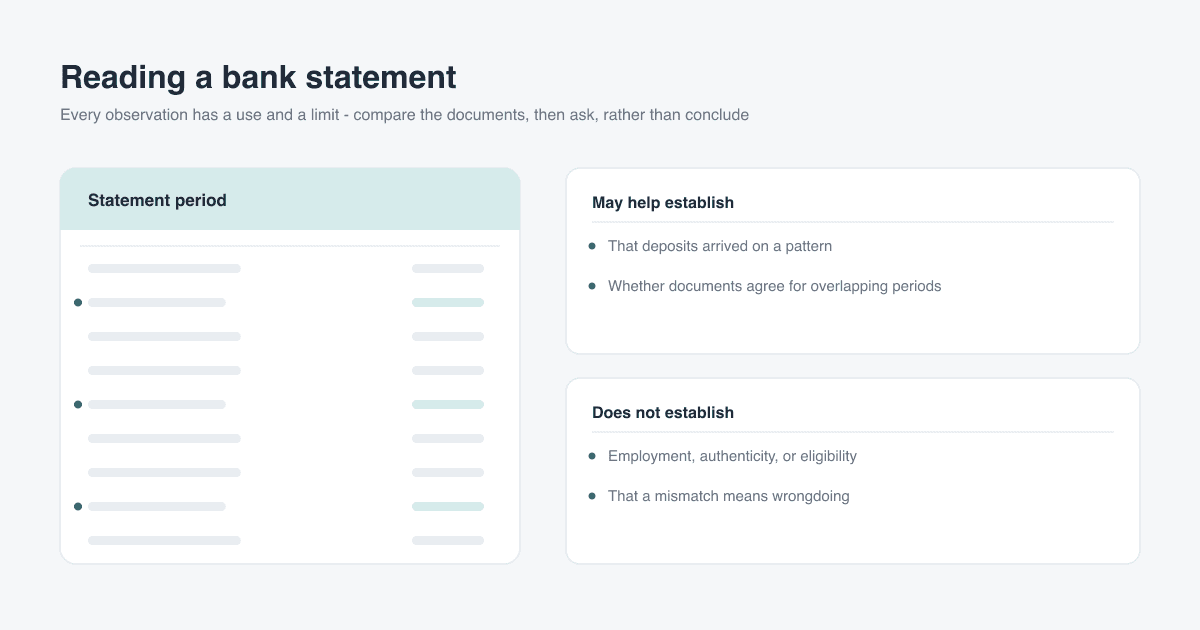
- A bank statement shows what entered and left an account over a period. It is evidence to compare against the other documents, not proof of employment, authenticity, or ability to pay.
- Deposit patterns are usually the useful signal; balances are usually the misleading one, because a single transaction near the period end can move a closing balance substantially.
- Not every credit is income - transfers between an applicant's own accounts, refunds, and reimbursements inflate totals if you count them as earnings.
- Deposit labels are set by banks and payment processors, so a label that does not match an employer name is unremarkable on its own.
- When something does not line up, you have a specific, factual question to ask - not a conclusion about the applicant.
A bank statement is one of the more useful documents in a rental application, and one of the easiest to over-read. It records what entered and left an account across a period, which makes it good for a single job: checking whether the money an applicant says they earn actually shows up, on the pattern they described. It is much weaker at everything else people try to use it for.
- Bank statement review
Reading the account activity an applicant submits to check whether it is consistent with the income they stated and with the other documents they provided. It is a comparison between records - not an audit of the applicant's finances, a confirmation that any document is genuine, or a measure of whether they can afford the rent.
The distinction matters because a statement records movement, not entitlement. It can show that a payment of a certain size arrived on a certain date. It cannot show who sent it, why, or whether it will arrive again. Those questions need other evidence, or an answer from the applicant. For the field-by-field method on the document a statement is most often compared against, see how to review a pay stub.
What each part may and may not tell you
Use this as the reference while you read. Every row has a limit as well as a use, and the limits are the part that keeps a review fair.
| What you are looking at | What it may help establish | What it does not establish | Reasonable follow-up |
|---|---|---|---|
| Opening and closing balances | That the account was open and active across the period shown, and roughly how the balance moved over it. | Financial stability, or whether the applicant can afford the rent. A single large credit or debit near the period end can move a closing balance substantially. | If the balance is the only thing you are relying on, it is usually the wrong signal - look at the income deposits instead. |
| Recurring deposits of a similar amount on a regular cadence | That money arrived in the account on a pattern, and whether that pattern is consistent with the pay frequency the applicant stated. | Who the employer is, that the applicant is currently employed, or that the deposits will continue. | Compare the deposit cadence and amounts against the pay stubs for the same period, and ask about any period the statements do not cover. |
| Deposit amounts compared against net pay on a pay stub | Whether the documents are consistent with one another for the periods that overlap. | That either document is genuine. Amounts can differ legitimately - split deposits, a mid-period deduction change, or a garnishment all move net pay. | Where a figure does not reconcile, ask a specific, factual question about that period rather than drawing a conclusion. |
| The description or source label on a deposit | A possible link between a deposit and a payer, when the label happens to be descriptive. | The employer relationship. Labels are set by banks and payment processors, are frequently truncated or generic, and may name a payroll provider rather than the employer. | Treat a label that does not match as unremarkable on its own; if the payer matters to your review, ask the applicant which deposits correspond to their income. |
| Deposits from more than one source | That income may come from several places - a second job, self-employment, benefits, support payments, or a household contribution. | That anything is being concealed. Multiple income sources are ordinary, and an applicant is not obliged to have a single employer. | If the application states an income figure you cannot tie to the documents, ask which sources make it up and what evidence exists for each. |
| Transfers, refunds, and reimbursements | Context for totals - not all money entering an account is income. | Additional income. Counting transfers between an applicant's own accounts, expense reimbursements, or refunds as earnings overstates what the applicant actually earns. | Separate one-off credits from the recurring pattern before comparing totals against a stated income. |
| A deposit dated a few days from the pay date on a stub | Normal settlement behaviour - posting dates commonly differ from pay dates, and weekends and holidays shift them further. | An inconsistency. A small timing gap between a pay date and a posting date is expected, not a discrepancy. | Compare the cadence across the period rather than matching individual dates exactly. |
| Missing pages, a partial period, or an unreadable copy | Only that the record in front of you is incomplete. | That anything was withheld. Statements are commonly exported partially, and page 4 of 6 is usually an export artifact, not a decision by the applicant. | Request the complete statement for the period, and apply the same request to every applicant whose documents arrive incomplete. |
How to review the statement
The same sequence every time, so the review is comparable across applicants.
Confirm what the document covers
Check the period the statement spans and that the pages are complete and legible. Note what it does not cover - you can only compare periods you actually have.
Find the recurring pattern
Identify the deposits that repeat at a regular cadence in a similar range. This is the part of the statement that carries most of the useful information.
Set aside the one-off credits
Separate transfers, refunds, and reimbursements from the recurring pattern before you compare anything against a stated income.
Counting these as earnings is the most common way a bank statement review overstates income.
Compare against the pay stubs and the application
Check whether the cadence and the amounts are consistent with the pay frequency and net pay shown elsewhere, for the periods that overlap.
How to review a pay stubTurn anything that does not line up into a question
Write down the specific figure, date, or period involved, and ask about that. A gap in the documents is a request for information, not a finding about the applicant.
Record what you reviewed
Note which periods you checked, what you compared, what you found, and anything you requested - so the same review can be shown for every applicant.
How many statements to ask for
There is no universal answer. A single statement can be enough when income is regular and the pay stubs cover the same period; more periods help when pay varies, income comes from several sources, or one period contains something unusual. Because each additional statement also hands you more of an applicant's spending history than the review needs, ask for what the review uses and no more - then apply that same rule to everyone, written down as part of your criteria. The equivalent question for pay stubs, and the pay-frequency reasoning behind it, is covered in how many pay stubs to request.
Handling the document responsibly
A bank statement is among the most revealing documents an applicant will ever hand you. It contains their spending, not just their earnings, and your review needs almost none of it.
When the documents disagree
Disagreement between documents is common and usually mundane: a deposit smaller than net pay may be a split deposit, a missing period may be an export that stopped early, an unfamiliar payer may be a payroll provider. Treat each as an open question with a specific answer, asked the same way for every applicant. For the full method, see handling missing, unreadable, or conflicting documents.
Scope and limits
How Fidem structures this
Sources
- Understanding Your Pay Stub — Consumer Financial Protection Bureau (accessed 2026-07-13)
- Protecting Personal Information: A Guide for Business — Federal Trade Commission (accessed 2026-07-13)
- Using Consumer Reports: What Landlords Need to Know — Federal Trade Commission (accessed 2026-07-13)
- HUD Handbook 4350.3, Chapter 4 - Waiting List and Tenant Selection — U.S. Department of Housing and Urban Development (accessed 2026-07-13)
- Fair Housing Act (Title VIII of the Civil Rights Act of 1968) — U.S. Department of Housing and Urban Development (accessed 2026-07-13)
Pay-stub field references, used here for cross-document comparison, follow the CFPB's consumer-education tool. Secure-handling and data-minimization guidance cites the FTC's guide for businesses. The consistently-applied-criteria principle is cited to HUD Handbook 4350.3, which is written for HUD-assisted housing and is used here as the clearest written articulation of that principle rather than as a rule binding market-rate landlords; the non-discrimination anchor is the Fair Housing Act itself. The consumer-report and adverse-action boundary is cited to the FTC's guidance for landlords. All sources verified on the access dates shown. Product statements describe Fidem's document-review workflow only. No statistics are used, and no jurisdiction-specific rule is asserted as universal.