
Key Takeaways
- No single number fits every applicant. What a review needs is enough coverage to see a pattern, and that depends on how the applicant is paid.
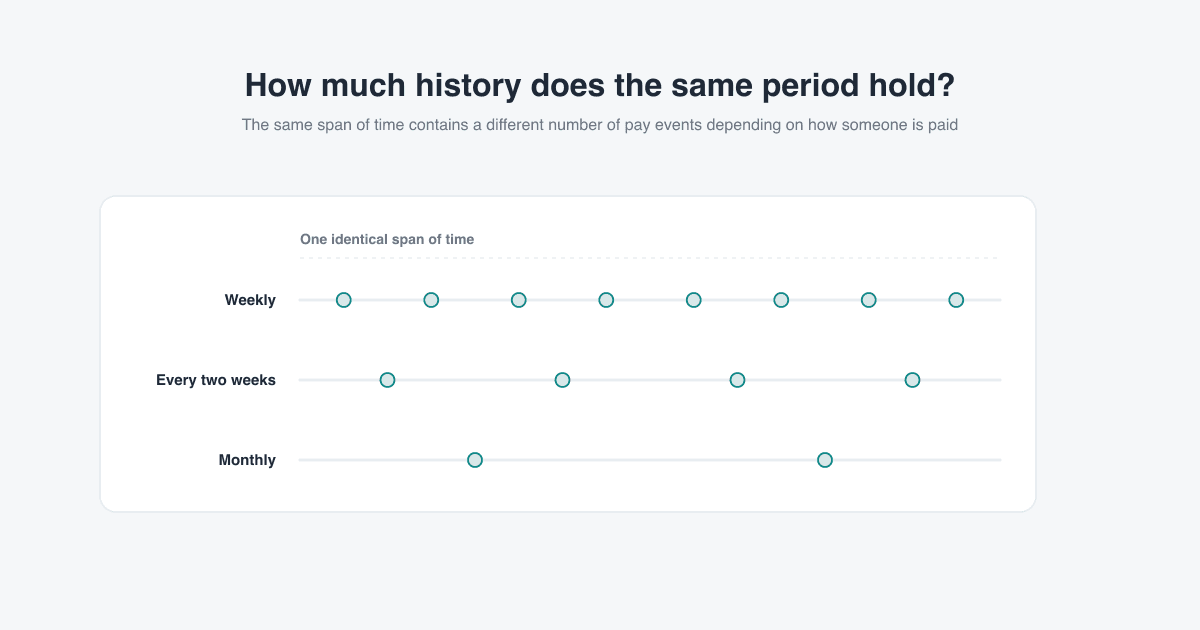
- A monthly pay stub can cover a whole month on its own; a weekly stub covers a fraction of one. The same period takes a different number of documents.
- Variable pay, a recent start date, and multiple income sources are the situations where more coverage genuinely helps.
- Many applicants receive no pay stubs at all - self-employment, contract, gig, retirement, and benefit income are documented differently, and asking for a document that does not exist is not a test anyone can pass.
- Decide your approach in advance, apply it the same way to every applicant, and treat a gap as a question to ask rather than a conclusion.
The usual answer to this question is a number - two months, three months, "the last three stubs." A fixed number is easy to write into a policy, and it is wrong often enough to be worth replacing.
The reason is simple: a pay stub is not a unit of time. A monthly stub can document an entire month of earnings on its own. A weekly stub documents about a quarter of one. Asking every applicant for the same count of documents asks for wildly different amounts of history depending on how they happen to be paid - and asks for something impossible from the many applicants who receive no pay stubs at all.
What the coverage is for
A pay-stub review establishes a small number of things: that stated income is supported by documentation, that the figures are internally consistent, and that the pattern is stable enough to be meaningful. For the field-level method, see how to review a pay stub.
Year-to-date totals do much of this work already - a single stub carries the year's accumulation with it, so if year-to-date is consistent with the stated rate and the number of periods elapsed, that is a meaningful check from one page. What additional periods buy you is pattern: whether earnings are steady, whether a given period was typical, and whether the documents agree with each other over the same weeks.
Coverage by pay situation
Use the applicant's actual pay pattern to decide, not a fixed count.
| Pay situation | What a single pay stub shows | Coverage that usually helps | Alternative evidence |
|---|---|---|---|
| Paid weekly | One week of earnings - a short window, and a small share of a month, so one stub says little about the pattern. | Enough consecutive weeks to cover roughly a month or two, which is where a weekly cadence becomes visible. | An employment letter stating pay rate and schedule, or bank statements showing the deposit cadence. |
| Paid every two weeks | One two-week period, plus a year-to-date total that already carries the history with it. | A few consecutive periods, which is usually enough to see whether year-to-date accumulates as the pay rate implies. | An employment letter, or bank statements covering the same weeks. |
| Paid semi-monthly or monthly | A larger share of the picture than a weekly stub - a monthly stub can cover an entire month of earnings on its own. | Fewer documents than a weekly pattern needs. One or two recent periods often covers the same ground. | An employment letter, or a bank statement showing the matching monthly deposit. |
| Commission, tips, overtime, or seasonal work | One point in a range that moves. A single period can sit well above or well below the applicant's typical earnings. | A longer span than a fixed salary needs, so a high or low period is read in context rather than mistaken for the norm. | A prior-year tax return or W-2 showing annual totals, or an employer letter describing the pay structure. |
| Recently started the job | Genuine, current evidence - simply not much of it yet. A short history reflects the start date, nothing more. | Whatever periods exist since the start date. Asking for more than the job has produced is not a test the applicant can pass. | A signed offer or employment letter stating start date, rate, and schedule. |
| Self-employed, contract, or gig work | Usually nothing - most people in this situation do not receive pay stubs at all, and no fixed document set replaces them. | Not applicable. Ask what evidence of income the applicant does have, rather than for a document that does not exist. | Tax returns or IRS transcripts, 1099 forms, invoices, or business bank statements showing the deposit pattern. |
| Retirement, disability, or benefit income | Also usually nothing - this income is documented by award or verification letters rather than by payroll stubs. | Not applicable. A current benefit verification letter generally covers what several stubs would. | A Social Security benefit verification letter, a pension or annuity statement, or bank statements showing the recurring deposit. |
For the full mapping of income types to the documents that evidence them, see proof of income by employment type.
Not everyone receives a pay stub
This is the part a fixed-count policy handles worst. No federal law requires an employer to issue a pay stub at all - the Fair Labor Standards Act requires employers to keep payroll records, and pay-stub issuance rules are set at state level and vary. Self-employed, contract, and gig workers generally have no payroll stub to produce, and retirement or benefit income is documented by an award or verification letter instead.
Choosing your approach
A workable approach states the coverage you are looking for, accepts equivalents, and is written down before you start reviewing.
Something like: documentation covering the applicant's recent income, sufficient to show the current pattern - typically the most recent pay periods for someone on a regular payroll, or comparable documentation such as tax records, benefit letters, or business bank statements where pay stubs do not apply.
That formulation does the work a number was supposed to do, without breaking on the applicants a number breaks on. Whatever you choose, apply it the same way to everyone. HUD's tenant-selection handbook articulates the standard as screening criteria consistently applied to all applicants; the consistency is what makes a review comparable and defensible.
Two further points worth deciding in advance:
Collect what the review uses, and no more. Additional periods mean additional personal financial detail in your possession. Coverage that genuinely helps is worth requesting; coverage requested out of habit is not.
A gap is a question, not a finding. Non-consecutive periods, a missing stub, or a short history are all ordinary and usually have mundane explanations. Ask about the specific period. For the general method, see handling missing, unreadable, or conflicting documents.
More is not automatically better. Additional periods do real work when earnings vary, when income comes from several sources, when the application figure and the documents do not agree, or when one period contains a bonus, correction, or unpaid leave that is easy to misread alone. Outside situations like those, extra periods usually add paperwork and personal data rather than information.
Scope and limits
How Fidem structures this
Sources
- Recordkeeping and Reporting (FLSA; 29 CFR Part 516) — U.S. Department of Labor (accessed 2026-07-14)
- Understanding Your Pay Stub — Consumer Financial Protection Bureau (accessed 2026-07-13)
- Manage Taxes for Your Gig Work — Internal Revenue Service (accessed 2026-07-14)
- How Can I Get a Benefit Verification Letter? — U.S. Social Security Administration (accessed 2026-07-14)
- HUD Handbook 4350.3, Chapter 4 - Waiting List and Tenant Selection — U.S. Department of Housing and Urban Development (accessed 2026-07-13)
- Fair Housing Act (Title VIII of the Civil Rights Act of 1968) — U.S. Department of Housing and Urban Development (accessed 2026-07-13)
The absence of a federal pay-stub issuance requirement, and the existence of FLSA payroll-recordkeeping duties, are cited to the U.S. Department of Labor; state-level variation is flagged rather than enumerated. Pay-stub field and year-to-date references follow the CFPB's consumer-education tool. Self-employment and gig documentation is cited to the IRS, and benefit-income documentation to the SSA. The consistently-applied-criteria principle is cited to HUD Handbook 4350.3, which is written for HUD-assisted housing and is used here as the clearest written articulation of that principle rather than as a rule binding market-rate landlords; the non-discrimination anchor is the Fair Housing Act itself. All sources verified on the access dates shown. Product statements describe Fidem's document-review workflow only. No statistics are used, and no jurisdiction-specific rule is asserted as universal.